Peer-Reviewed
Publications
I am proud to have contributed to the following publications. However, it should be noted that scientific publication is prone to errors. Not all these merit retractions or the issuing of an erratum. Nonetheless, in my honest opinion, it would benefit research if we were to collectively use such tools more often. Lowering the barrier for error reporting and providing transparency would help us take the responsible course of action in clearing up issues, such that these do not affect other researchers. Here, I list those issues that I am aware of in my own publishing presently. Some of the comments below you may find out of place, including examples where I felt coerced to publish material that was substandard or where the authors knew there were issues with the (description of the) physics. I have given these matters long thought and presently feel right about the way the comments are framed. However, I keep working on the wording as I change my thinking on science and how to best address issues. Please let me know if you would like to see something phrased differently or if you find any other issues; I would be happy to update this page.
- J. de Graaf, The Geometry behind the Glass Transition and Frictional Jamming in Systems of Two-Dimensional Hard Disks, under revision (2026)
The original version that was prepared for submission late 2024, was rough in several aspects. I was quite excited by my finding, but simultaneously I wrote a rather confusing and overly ambitious paper. Since that time, I have refined my analysis and conclusions substantially. These are presented in the 2nd version of the arxiv paper, which is still not without blemishes, but tells a more consistent and concise story. I am presently waiting for peer-review feedback on another iteration and will likely upload another arxiv, when I make the next step in pitching this story.
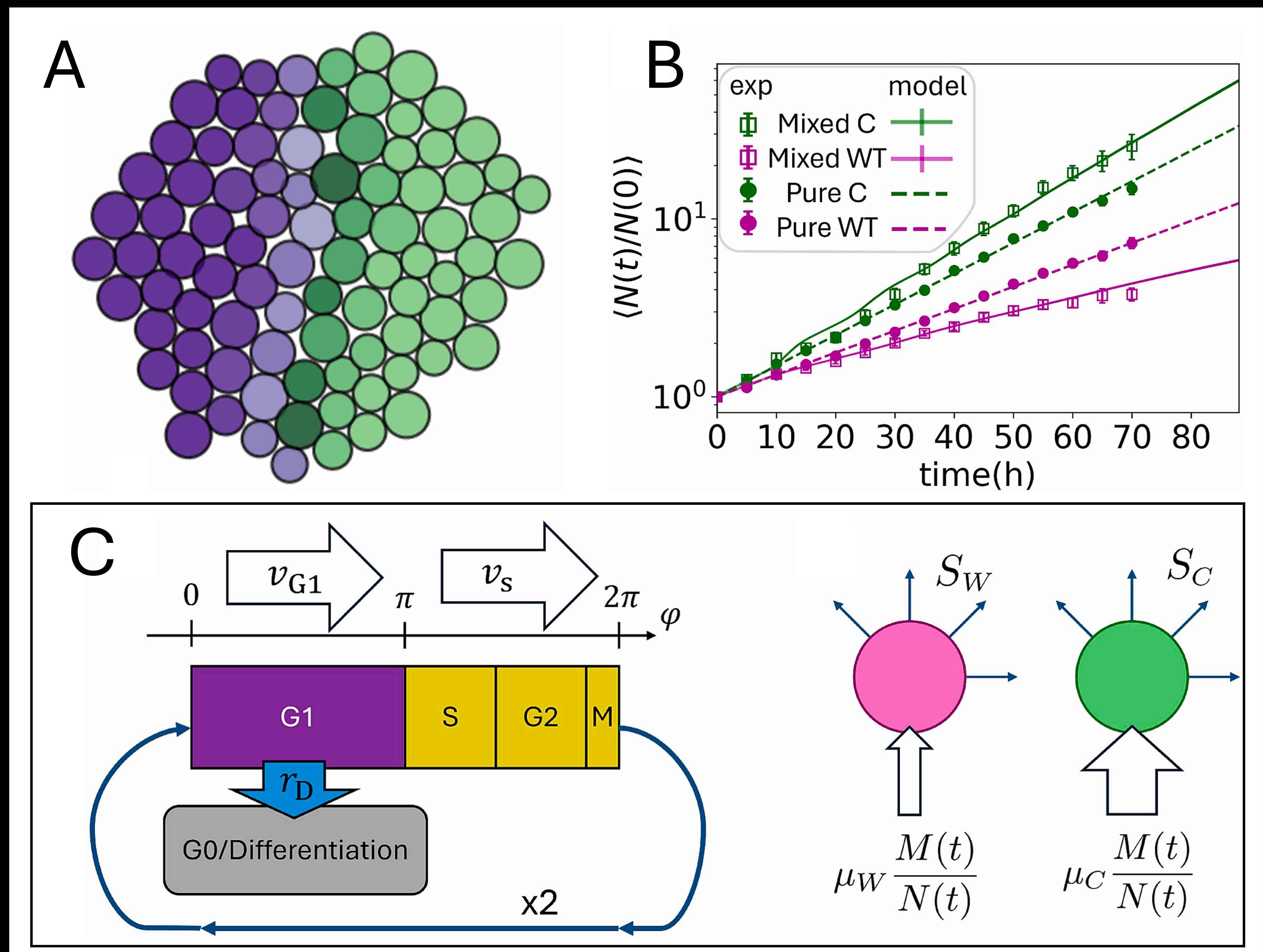
- H. Nemati, S. Suijkerbuijk, and J. de Graaf, Cell Competition Driven by Secreted Ligands: Modeling Liver Metastasis of Colorectal Cancer, Proc. Natl. Acad. Sci. 123, e2531078123 (2025)
- L. Eij, J. de Graaf, M. Haase, and J. Steenhoff, Phase-Field Models for Particle-Stabilized Emulsions, J. Chem. Phys. 164, 124902 (2026)
- G. Rempfer, M. Nesenberend, C. Zhu, B. Stam, D. Panja, and J. de Graaf, Projection-Based Solver for Viscoelastic Stokes Flow using Fast Fourier Transforms, Phys. Rev. Fluids 11, 084901 (2026)
- K. Torre and J. de Graaf, Hydrodynamic interactions in particle suspensions: Learning Stokesian dynamics, J. Rheol. 70, 917 (2026)
- B. Verhoef, R. Hermsen, and J. de Graaf, Fluid-derived lattices for unbiased modeling of bacterial colony growth, PloS one 20, e0330491 (2025)
- K. Torre, R. Schram, and J. de Graaf, Python-JAX-based fast Stokesian dynamics, SciPost Physics Codebases 056, 2 (2025)
The code base associated with this package is undergoing constant updates and revision. We have found a few minor bugs since publication. I strongly suggest that you talk with William Torre, the original developer, or Dimos Aslanis, my group member who is actively developing with the code, before you start using it. By all means, inform us of any issues that you find, and we would be happy to help you overcome them. Ultimately, we hope that by building on the original work of Andrew Fiore and James Swan, we can give everyone the opportunity to make use of hydrodynamic simulations with a substantially reduced learning curve.
- J. Melio, S. Riedel, A. Azadbakht, S. Caipa Cure, T. Evers, M. Babaei, A. Mashaghi, J. de Graaf, and D. Kraft, The motion of catalytically active colloids approaching a surface, Soft Matter 21, 2541 (2025)
In hindsight, it would have been nice to have referenced work by Popescu and Uspal, as well as work by the Maldarelli and Velegol groups; thank you for pointing that out Mihail.
- K. Torre and J. de Graaf, Delayed gravitational collapse of attractive colloidal suspensions, J. Fluid Mech. 1000, A73 (2024)
- H. Nemati and J. de Graaf, The cellular Potts model on disordered lattices, Soft Matter 20, 8337 (2024)
- M. Bos, A. Ermund, G. Hansson, and J. de Graaf, Goblet cell interactions reorient bundled mucus strands for efficient airway clearance, PNAS Nexus 2, pgad388 (2023)
- K. Torre and J. de Graaf, Hydrodynamic Lubrication in Colloidal Gels, Soft Matter 19, 7388 (2023)
There may be an issue with the way in which we implemented the two-step time integration. Whether this has affected the reported physics is currently under investigation. Note that we did our due diligence by checking various simplified geometries to see whether our results were producing the correct physics, which they seemed to do at the time. However, stochastic algorithms have subtleties that are sometimes difficult to pinpoint. We look forward to updating you on this matter soon.
- J. de Graaf, K. Torre, W. Poon, and M. Hermes, Hydrodynamic stability criterion for colloidal gelation under gravity, Phys. Rev. E 107, 034608 (2023)
- K. Torre and J. de Graaf, Structuring Colloidal Gels via Micro-Bubble Oscillations, Soft Matter 19, 2771 (2023)
- T. Welling, A. Grau-Carbonell, K. Watanabe, D. Nagao, J. de Graaf, M. van Huis, and A. van Blaaderen, Frequency-controlled electrophoretic mobility of a particle within a porous, hollow shell, J. Colloid Interface Sci. 627, 761 (2022)
- N. Narinder, M. Bos, C. Abaurrea-Velasco, J. de Graaf, and C. Bechinger, Understanding enhanced rotational dynamics of active probes in rod suspensions, Soft Matter 18, 6246 (2022)
- S. Ketzetzi, M. Rinaldin, P. Dröge, J. de Graaf, D. Kraft, Activity-induced microswimmer interactions and cooperation in one-dimensional environments, Nat. Commun. 13, 1772 (2022)
- A. Demirörs, S. Aykut, S. Ganzeboom, Y. Meier, R. Hardeman, J. de Graaf, A. Mathijssen, E. Poloni, J. Carpenter, C. Ünlü, and D. Zenhäusern, Amphibious Transport of Fluids and Solids by Soft Magnetic Carpets, Sci. Adv. 8, 2102510 (2021)
The modeling of the elastohydrodynamic effect is internally consistent and carried out correctly. Upon reflection, I do wonder how accurately it captures the physics of the experiment; I want to revisit this issue and more accurately account for viscoelasticity. Any issues with the descriptiveness of the modeling are not to be attributed to the student R. Hardeman, who carried out the numerical work and calculations and did an excellent job.
- T. Welling, K. Watanabe, A. Grau-Carbonell, J. de Graaf, D. Nagao, A. Imhof, M. van Huis, and A. van Blaaderen, Tunability of interactions between the core and shell in rattle-type particles studied with liquid-cell electron microscopy, ACS Nano 15, 11137 (2021)
- T. Huang, B. Ibarlucea, A. Caspari, A. Synytska, G. Cuniberti, J. de Graaf, and L. Baraban, Impact of surface charge on the motion of light-activated Janus micromotors, Euro. Phys. J. E 44, 39 (2021)
- M. Kuron, C. Stewart, J. de Graaf, C. Holm, An extensible lattice Boltzmann method for viscoelastic flows: complex and moving boundaries in Oldroyd-B fluids, Euro. Phys. J. E 44, 1 (2021)
We now know that the analysis of the peak in the viscoelastic stress has limitations, these have been identified and improved upon in Rempfer et al. Phys. Rev. Fluids above.
- A. Demirörs, A. Stauffer, C. Lauener, J. Cossu, S. Ramakrishna, J. de Graaf, C. Alcantara, S. Pané, N. Spencer, A. Studart, Magnetic propulsion of colloidal microrollers controlled by electrically modulated friction, Soft Matter 17, 1037 (2021)
- R. Verweij, S. Ketzetzi, J. de Graaf, and D. Kraft, Height distribution and orientation of colloidal dumbbells near a wall, Phys. Rev. E 102, 062608 (2020)
- C. Abaurrea-Velasco, C. Lozano, C. Bechinger, and J. de Graaf, Autonomously Probing Viscoelasticity in Disordered Suspensions, Phys. Rev. Lett. 125, 258002 (2020)
There was an oversight in terms of the referencing, which has been corrected via an erratum in which we explain that we missed a relevant paper that impacts the novelty claim to a degree. In addition, it is my current understanding that the model that we used does not have a glass transition in the sense of the experimental system by the Bechinger group. That is, we misidentified the jamming transition in our simulations as a glass transition. However, this does not impact the main message of the work, but it is admittedly annoying. My own work on the glass transition in this system, see above, attempts to rectify the missing element. All of the work we have done since on this system suggests strongly that the major elements of the paper hold, namely that a sort-range interaction with a changing neighborhood leads to reorientation with an asymmetry around dynamic arrest. This reordering is on a time scale that is fast compared to the data acquisition in the experiment, which explains why super-diffusive angular behavior of the probe was not observed in [Lozano et al., Nat. Mater. 18, 1118 (2019)]. This can also be appreciated from the follow-up study [Narinder et al., Soft Matter 18, 6246 (2022)].
- S. Ketzetzi, J. de Graaf, and D. Kraft, Diffusion-based height analysis reveals robust microswimmer-wall separation, Phys. Rev. Lett. 125, 238001 (2020)
- S. Ketzetzi, J. de Graaf, R. Doherty, and D. Kraft, Slip length dependent propulsion speed of catalytic colloidal swimmers near walls, Phys. Rev. Lett. 124, 048002 (2020)
- Z. Zhang, J. de Graaf, and S. Faez, Regulating the aggregation of colloidal particles in an electro-osmotic micropump, Soft Matter 16, 10707 (2020)
The modeling in the manuscript is internally consistent, though I question how well it captures the physics of the experiment. The reason for this is that no 'jamming' element is present in our single-particle model. If I were to revisit the calculations, I would have probably used a phase-field approach similar to the one in [Torre and de Graaf, J. Fluid Mech. 1000, A73 (2024)] to capture this aspect, though at the time we had not yet developed this approach.
- J. de Graaf and S. Samin, Self-Thermoelectrophoresis at Low Salinity, Soft Matter 15, 7219 (2019)
- M. Kuron, P. Stärk, C. Holm, and J. de Graaf, Hydrodynamic mobility reversal of squirmers near flat and curved surfaces, Soft Matter 15, 5908 (2019)
- M. Kuron, P. Stärk, C. Burkard, J. de Graaf, and C. Holm, A Lattice Boltzmann Model for Squirmers, J. Chem. Phys. 150, 144110 (2019)
In this work, we report lattice artefacts for a moving squimer. I suspect that the origin of these is a bug/inconsistency in the way boundary conditions are handled in the lattice-Boltzmann (LB) algorithm of WaLBerLa, rather than something intrinsically wrong with implementing squimers in LB. This is because both for the electrokinetic version [M. Kuron et al., J. Chem. Phys. 145, 214102 (2016)] and the viscoelastic version of the LB method [M. Kuron et al., Euro. Phys. J. E 44, 1 (2021)], we were unable to get self-propelled particles or squimers to work properly. In fact, for the latter, there was a clear artefact, which depended sensitively on the direction in which the squirmer traversed the simulation box. In addition, snow-man-like swimmers in a viscoelastic LB medium came to a halt, rather than that they continued to move with a constant velocity. That is, the behavior is indicative of a boundary-localized momentum leak. The presumed small bug in WaLBerLa is likely obscured by putting an external force on the object. Whenever the forces on the fluid are self-generated, as is the case with squirmers or snow-man particles, this effect is much more noticeable. We were aware enough that something was amiss at the time of publication to give us pause, for which I argued and was overruled. In conclusion, squirmer particles in LB likely do not require the diameters that we report in [M. Kuron et al., J. Chem. Phys. 150, 144110 (2019)].
- J. de Graaf, W.C.K. Poon, M.J. Haughey, and M. Hermes, Hydrodynamics strongly affect the dynamics of colloidal gelation but not gel structure, Soft Matter 15, 10 (2019)
- F. Weik, R. Weeber, K. Szuttor, K. Breitsprecher, J. de Graaf, M. Kuron, J. Landsgesell, H. Menke, D. Sean, and C. Holm, ESPResSo 4.0 -- An Extensible Software Package for Simulating Soft Matter Systems, Eur. Phys. J. S.T.
227, 1789 (2019)
- M. Palusa, J. de Graaf, A. Brown, and A. Morozov, Sedimentation of a rigid helix in viscous media, Phys. Rev. Fluids 3, 124301 (2018)
Some care needs to be taken in assigning the dynamics to the center of mass, which need not correspond to the hydrodynamic center. Recent work by my bachelor student Márton Krénusz shows that when the hydrodynamic center does not coincide with the center of mass, superhelical trajectories appear transient.
- A. Castelli, J. de Graaf, S. Marras, R. Brescia, L. Goldoni, L. Manna, and M. Arciniegas, Understanding and Tailoring Ligand Interactions in the Self-Assembly of Branched Colloidal Nanocrystals into Planar Superlattices, Nat. Commun. 9, 1141 (2018)
- R. Niu, P. Kreissl, A. Brown, G. Rempfer, D. Botin, C. Holm, T. Palberg, and J. de Graaf, Microfluidic Pumping by Micromolar Salt Concentrations, Soft Matter 13, 1505 (2017)
- A. Brown, W. Poon, C. Holm, and J. de Graaf, Ionic Screening and Dissociation are Crucial for Understanding Chemical Self-Propulsion in Polar Solvents, Soft Matter 13, 1200 (2017)
- G. Rempfer, S. Ehrhardt, C. Holm, and J. de Graaf, Nanoparticle Translocation through Conical Nanopores: A Finite Element Study of Electrokinetic Transport, Macromol. Theor. Simul. 26, 1600051 (2017)
- J. de Graaf and J. Stenhammar, Lattice-Boltzmann Simulations of Microswimmer-Tracer Interactions, Phys. Rev. E 95, 023302 (2017)
- M. Kuron, G. Rempfer, F. Schornbaum, M. Bauer, C. Godenschwager, C. Holm, and J. de Graaf, Moving Charged Particles in Lattice Boltzmann-Based Electrokinetics, J. Chem. Phys. 145, 214102 (2016)
- J. de Graaf and J. Stenhammar, Stirring by Periodic Arrays of Microswimmers, J. Fluid Mech. 811, 487 (2016)
- S. Ilse, C. Holm, and J. de Graaf, Surface Roughness Stabilizes the Clustering of Self-Propelled Triangles, J. Chem. Phys. 145, 134904 (2016)
- G. Rempfer, S. Ehrhardt, N. Laohakunakorn, G. Davies, U. Keyser, C. Holm, and J. de Graaf, Selective Trapping of DNA Using Glass Microcapillaries, Langmuir 32, 8525 (2016)
- G. Rempfer, G. Davies, C. Holm, and J. de Graaf, Reducing Spurious Flow in Simulations of Electrokinetic Phenomena, J. Chem. Phys. 145, 044901 (2016)
- P. Kreissl, C. Holm, and J. de Graaf, The Efficiency of Self-Phoretic Propulsion Mechanisms with Surface Reaction Heterogeneity, J. Chem. Phys. 144, 204902 (2016)
- J. de Graaf, A. Mathijssen, M. Fabritius, H. Menke, C. Holm, and T. Shendruk, Understanding the Onset of Oscillatory Swimming in Microchannels, Soft Matter 12, 4704 (2016)
- J. de Graaf, H. Menke, A. Mathijssen, M. Fabritius, C. Holm, and T. Shendruk, Lattice-Boltzmann Hydrodynamics of Anisotropic Active Matter, J. Chem. Phys. 144, 134106 (2016)
- A. Castelli, J. de Graaf, M. Prato, L. Manna, and M. Arciniegas, Tic-Tac-Toe Binary Lattices from the Interfacial Self-Assembly of Branched and Spherical Nanocrystals, ACS Nano 10, 4345 (2016)
- E. Sutter, P. Sutter, A. Tkachenko, R. Krahne, J. de Graaf, M. Arciniegas, and L. Manna, In Situ Microscopy of the Self-Assembly of Branched Nanocrystals in Solution, Nat. Commun. 7, 11213 (2016)
- J. de Graaf, T. Peter, L. Fischer, and C. Holm, The Raspberry Model for Hydrodynamic Interactions Revisited. II. The Effect of Confinement, J. Chem. Phys. 143, 084108 (2015)
This paper contains minor mistakes that I have corrected and identified in the latest arXiv version of the manuscript in bold face.
- L. Fischer, T. Peter, C. Holm, and J. de Graaf, The Raspberry Model for Hydrodynamic Interactions Revisited. I. Periodic Arrays of Spheres and Dumbbells, J. Chem. Phys. 143, 084107 (2015)
This paper contains minor mistakes that I have corrected and identified in the latest arXiv version of the manuscript in bold face.
- J. de Graaf, G. Rempfer, and C. Holm, Diffusiophoretic Self-Propulsion for Partially Catalytic Spherical Colloids, IEEE Trans. Nanobiosci. 14, 272 (2015)
- A. Gantapara, J. de Graaf, R. van Roij, and M. Dijkstra, Phase Behavior of a Family of Truncated Hard Cubes, J. Chem. Phys. 142, 054904 (2015)
- B. Peng, G. Soligno, M. Kamp, B. de Nijs, J. de Graaf, M. Dijkstra, R. van Roij, A. van Blaaderen, and A. Imhof, Site-Specific Growth of Polymers on Silica Rods, Soft Matter 10, 9644 (2014)
- M. Arciniegas, M. Kim, J. de Graaf, R. Brescia, S. Marras, K. Miszta, M. Dijkstra, R. van Roij, and L. Manna, Self-Assembly of Octapod-Shaped Colloidal Nanocrystals into a Hexagonal Ballerina Network Embedded in a Thin Polymer Film, Nano Lett. 14, 1056 (2014)
- A. Gantapara, J. de Graaf, R. van Roij, and M. Dijkstra, Phase Diagram and Structural Diversity of a Family of Truncated Cubes: Degenerate Close-Packed Structures and Vacancy-Rich States, Phys. Rev. Lett. 111, 015501 (2013)
- W. Qi, J. de Graaf, F. Qiao, S. Marras, L. Manna, and M. Dijkstra, Phase Diagram of Octapod-shaped Nanocrystals in a Quasi-Two-Dimensional Planar Geometry, J. Chem. Phys. 138, 154504 (2013)
- J. de Graaf, L. Filion, M. Marechal, M. Dijkstra, and R. van Roij, Crystal-structure prediction via the Floppy-Box Monte Carlo algorithm: Method and application to hard (non)convex particles, J. Chem. Phys. 137, 214101 (2012)
- W. Evers, B. Goris, S. Bals, M. Casavola, J. de Graaf, R. van Roij, M. Dijkstra, and D. Vanmaekelbergh, Low-Dimensional Semiconductor Superlattices Formed by Geometric Control over Nanocrystal Attachment, Nano Lett. 13, 2317 (2012)
The proposed argument for the orientation of the nanocrystals is overly simplified, this model was subsequently improved upon in [G. Soligno, M. Dijkstra, and R. van Roij, Phys. Rev. Lett. 116, 258001 (2016)].
- J. de Graaf, N. Boon, M. Dijkstra, and R. van Roij, Electrostatic Interactions between Janus Particles, J. Chem. Phys. 137, 104910 (2012)
- W. Qi, J. de Graaf, F. Qiao, S. Marras, L. Manna, and M. Dijkstra, Ordered Two-Dimensional Superstructures of Colloidal Octapod-Shaped Nanocrystals on Flat Substrates, Nano Lett. 12, 5299 (2012)
- R. Ni, A. Gantapara, J. de Graaf, R. van Roij, and M. Dijkstra, Phase Diagram of Colloidal Hard Superballs: from Cubes via Spheres to Octahedra, Soft Matter 8, 8826 (2012)
- J. de Graaf, R. van Roij, and M. Dijkstra, Dense Regular Packings of Irregular Nonconvex Particles, Phys. Rev. Lett. 107, 155501 (2011)
- K. Miszta, J. de Graaf, G. Bertoni, D. Dorfs, R. Brescia, S. Marras, L. Ceseracciu, R. Cingolani, R. van Roij, M. Dijkstra, and L. Manna, Hierarchical Self-Assembly of Suspended Branched Colloidal Nanocrystals into Superlattice Structures, Nat. Mater. 10, 872 (2011)
- J. de Graaf, M. Dijkstra, and R. van Roij, Adsorption Trajectories and Free-Energy Separatrices for Colloidal Particles in Contact with a Liquid-Liquid Interface, J. Chem. Phys. 132, 164902 (2010)
- J. de Graaf, M. Dijkstra, and R. van Roij, Triangular Tessellation Scheme for the Adsorption Free Energy at the Liquid-Liquid Interface: Towards Nonconvex Patterned Colloids, Phys. Rev. E 80, 051405 (2009)
- M. Bier, J. de Graaf, J. Zwanikken, and R. van Roij, Curvature Dependence of the Electrolytic Liquid-Liquid Interfacial Tension, J. Chem. Phys. 130, 024703 (2009)
- J. de Graaf, J. Zwanikken, M. Bier, A. Baarsma, Y. Oloumi, M. Spelt and R. van Roij, Spontaneous Charging and Crystallization of Water Droplets in Oil, J. Chem. Phys. 129, 194701 (2008)
- J. Zwanikken, J. de Graaf, M. Bier, and R. van Roij, Stability of Additive-Free Water-in-Oil Emulsions, J. Phys.: Condens. Matter 20, 494238 (2008)